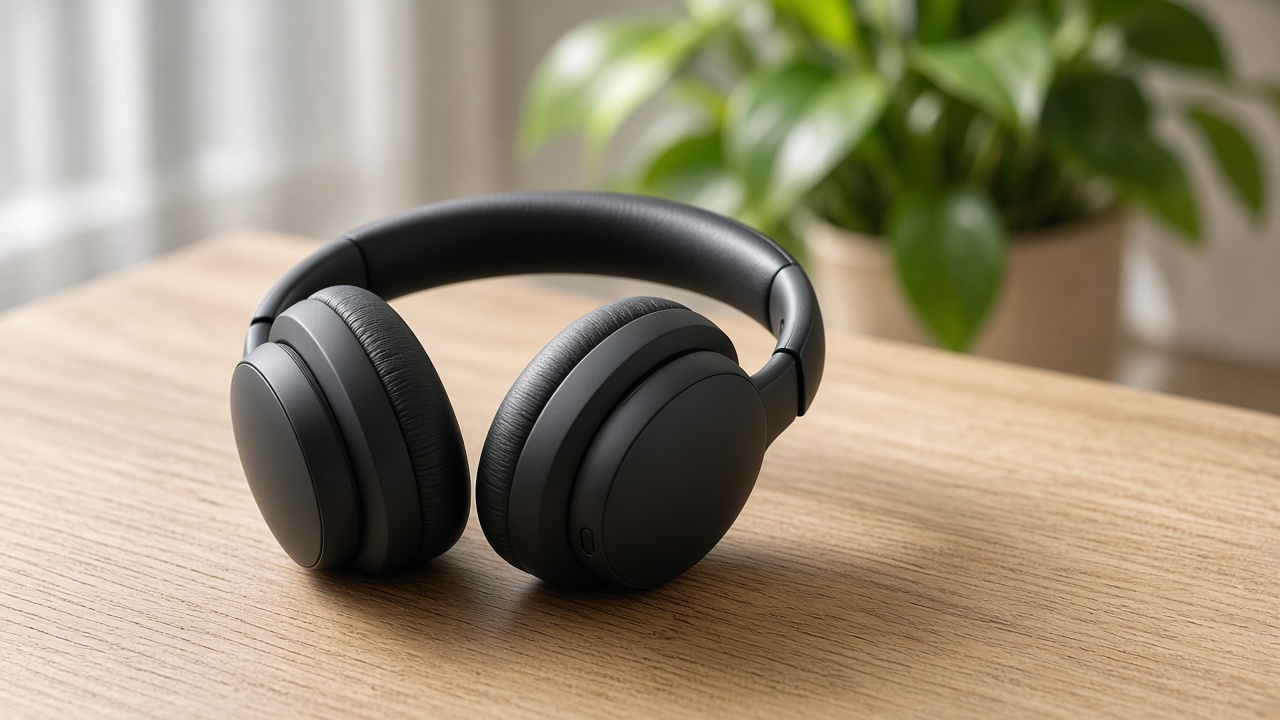
Most headphones feel wonderful for twenty minutes. The clamp is a hug, the first song is louder than your old pair, and the case clicks shut with a satisfying magnet. June is the real review. By then you know whether the band leaves a stripe in your hair, whether the cushions heated up on a long call, and whether you stopped charging them because the case never lived where you set your keys.
Start with the hours you actually wear them
Write down three sessions before you look at a product page. A commute, a work block, and an evening on the sofa are enough. If two of those sessions are longer than an hour, start with over-ear headphones. Earbuds win on pockets and lose on pressure. A stem that felt clever in a shop becomes a lever against your glasses. The Aurora Wireless Headphones are in our catalog because the cushion is deep enough for frames and the battery covers a workday plus the evening after it. The Pulse Mini Earbuds are the other answer: calls, walks, and the days you refuse to carry a case the size of a book.
Seal is the feature hiding under the branding
Bass you can feel in a quiet room is often just a good seal. If the cushion leaks, the pair will sound thin and you will turn it up, which is how listening fatigue starts. For earbuds, three tip sizes are not a luxury. Try the largest tip that still sits comfortably. If your ear hurts in ten minutes, the tip is wrong even if the app says the fit test passed. For over-ears, slide the cup until the whole ear sits inside, then walk to the kitchen. A seal that only works if you hold your head still is not a seal.
Battery claims need a translation
A number like “thirty hours” usually assumes half volume and no noise tools. That is still useful if you treat it as a ceiling. Ask instead: can I forget the charger on a two-day trip? Aurora’s listing says up to thirty-six hours because that is the ceiling, and the practical day is still a full work session. Pulse is honest in the other direction. Seven hours in the ears and a case that refills them is the right shape for a pocket, not for a flight where you will not open the case.
Charge ports matter as much as capacity. A pair that still wants a special cable will spend its life at five percent. USB-C shared with your phone is the standard we look for. The Volt 65W Charger can feed a notebook while the headphone cable waits its turn. One brick, two jobs.
Calls are a different product
Music demos hide bad microphones. If you take calls, test the mic in the room where you actually talk, which is rarely a silent booth. A beam-forming mic on earbuds helps when the room is quiet and fails when a kettle is boiling. Over-ears with a boom are still the better tool for a noisy kitchen, and we would rather say that than pretend a tiny hole on the stem is magic. If the camera on your calls matters too, pair the audio decision with the Nimbus Webcam, which has a shutter you can see closed.
A short test you can do this week
- Wear the pair for one real work block, not a song.
- Take one call from the room you use most.
- Pack them the way you pack your keys, then see if they are charged the next morning.
- Listen to a podcast at the volume you would use beside someone else. If you have to raise it, the seal is wrong.
If a pair fails one of those and you still love the way it looks, keep looking. The catalog is short on purpose. When you are ready, the audio shop is the list we would buy from ourselves, and the packing note covers the charger you will wish you had brought.